Drop CSV file here or click to browse
Column Mapping
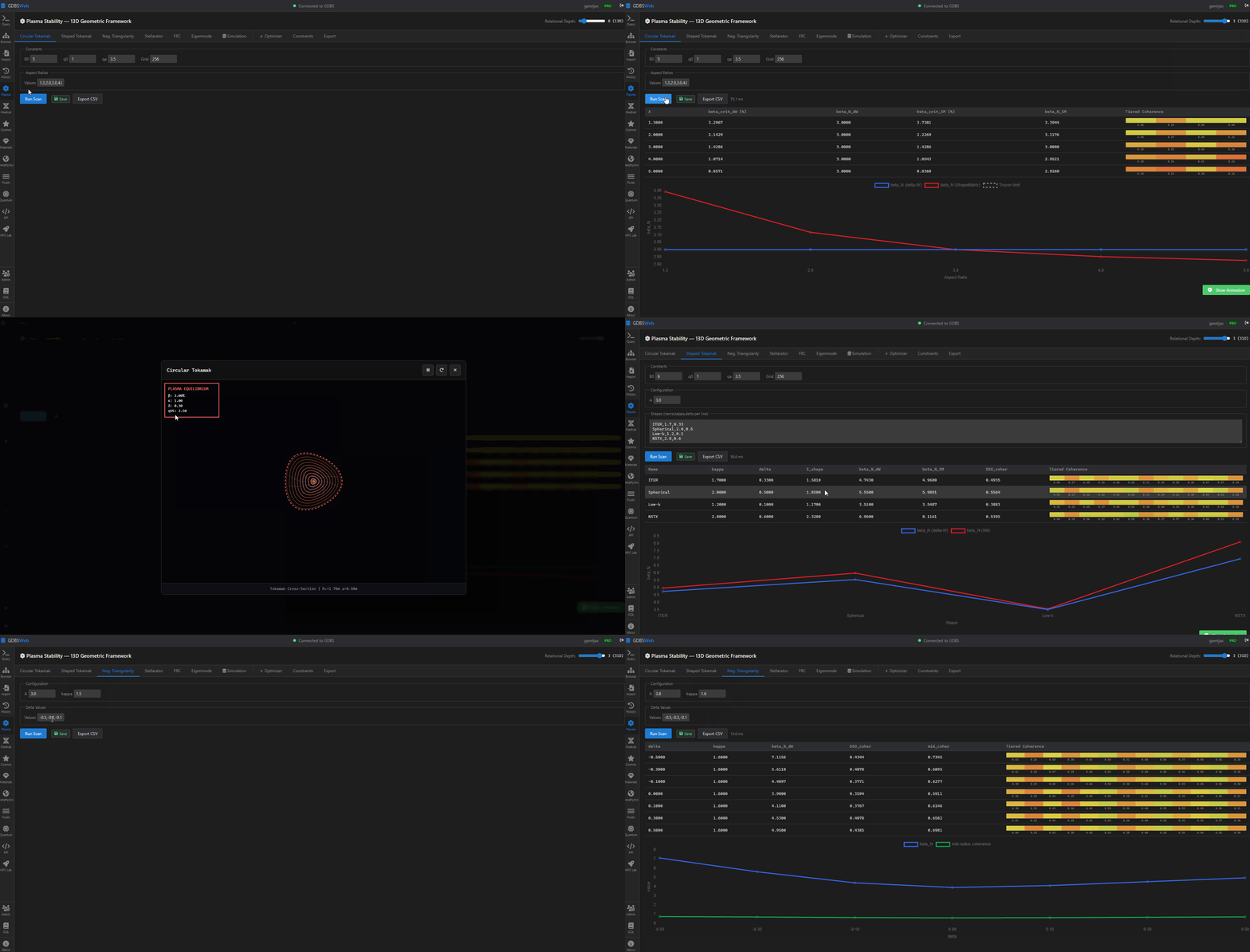
Plasma Stability — 13D Geometric Framework
Optimizer — Auto-Tuning
Grid search across the full parameter space to find optimal plasma configurations. Evaluates thousands of candidates and ranks them by your target metric.
PROUpgrade to unlock auto-tuning and advanced features.
Custom Constraints
Define your specific machine parameters, engineering limits, and operational constraints. Set bounds on field strength, current, wall loading, and divertor heat flux.
PROAvailable with Full Suite and Enterprise licenses.
Active Constraints
Export Full Datasets
Export complete simulation datasets in CSV, JSON, and HDF5 formats. Includes full grid data, eigenmode profiles, and convergence diagnostics.
PROAvailable with Full Suite and Enterprise licenses.
Medical Module — Molecular Nanoinformatics
Drug-target binding, protein stability, nanoparticle design, drug interactions, and molecular QSAR. Powered by the same 13D geometric engine.
MODULEContact sales to unlock the Medical Module.
Medical — Molecular Nanoinformatics
Shrake-Rupley Algorithm: SASA computed using Fibonacci lattice sphere sampling. Van der Waals radii from Bondi (1964). Multiple probe radii reveal cavity accessibility and solvent size effects.
Cosmos Module — DSO Cosmological Framework
Galaxy rotation curves, CMB power spectrum, black hole jets, fundamental constants from golden ratio, and cosmic energy budget. Powered by the same 13D geometric engine.
MODULEContact sales to unlock the Cosmos Module.
Cosmos — DSO Framework
Materials Science
Module 4Geophysics
Module 5Fluid Dynamics
Module 6Quantum Information
Module 7Saved Runs
HPC Lab
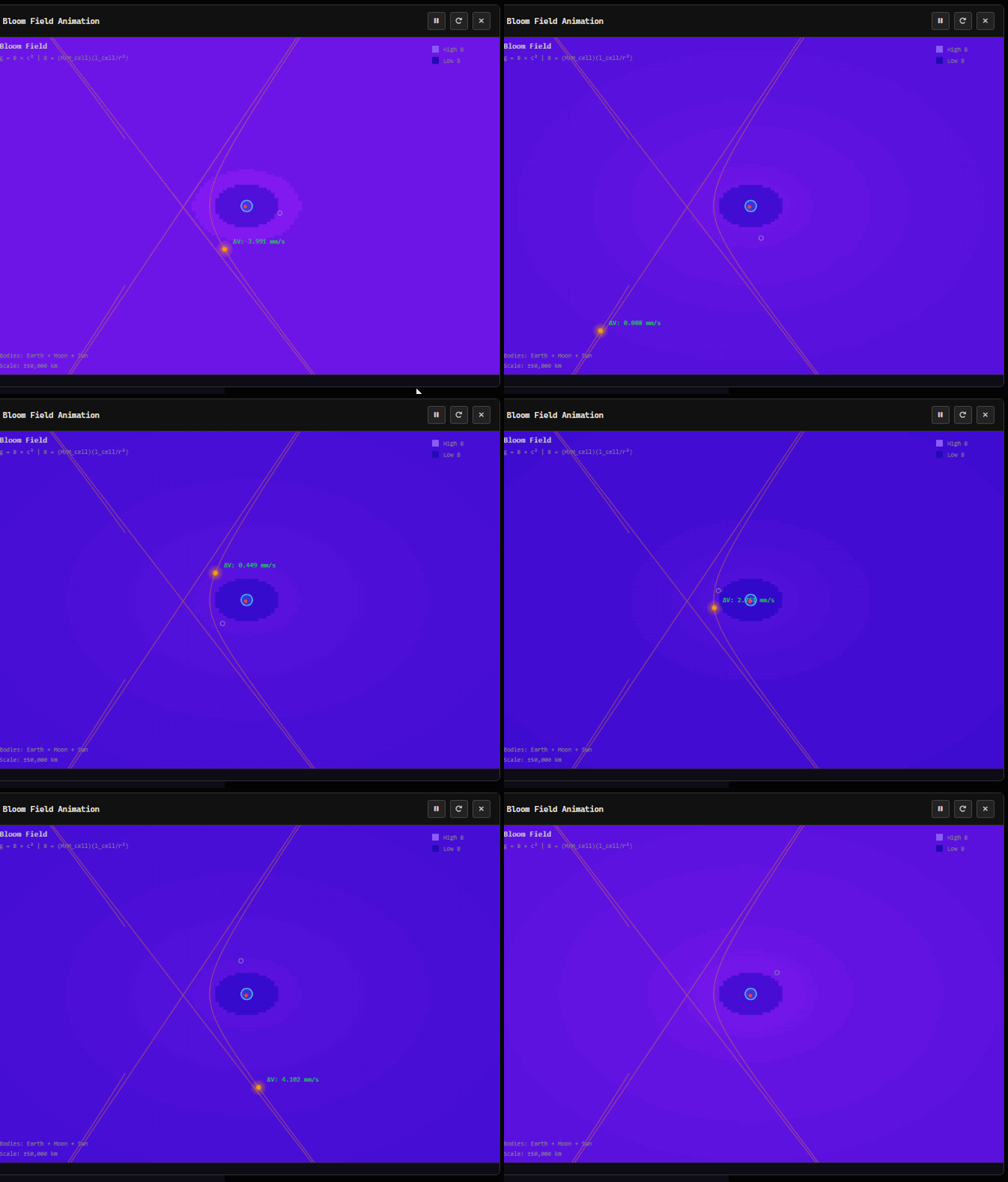
Transport, Phase Diagrams, FEM, MD, Helicity, Ballistics, Bloom Fields, and Batch Processing
GeoNum — Geometric Number System
Piecewise-approximate arithmetic with first-class drift tracking. Numbers are field intensities; uncertainty is explicit, not hidden.
§ Formal Specification
Approximation class. GeoNum is piecewise approximate with O(1/2048) quantization error per zone, drift-tracked. It is not exact arithmetic and does not claim to be. The honest statement: each encode operation introduces quantization error ε_q ∈ [0, 1/2047) shade units, systematic downward bias (truncation). After N operations the reported drift is a running indicator of accumulated error, not a tight bound.
3.1 Encoding
Given x ∈ ℝ, x ≠ 0:
  σ  = sign(x)
  ℓ  = log₁₀|x|         [IEEE 754 Math.log10]
  z  = min{k ∈ ℤ : B_k > ℓ}   [zone boundaries {B_k}, half-open: B_{z-1} ≤ ℓ < B_z]
  W_z = B_z − B_{z−1}           [zone width in log₁₀ space]
  ι  = (ℓ − B_{z−1}) / W_z ∈ [0, 1)   [normalized intensity]
  s  = ⌊ι × 2047⌋                       [shade — truncation, NOT round-to-nearest]
  δ₀ = ι × 2047 − s  ∈ [0, 1)          [initial quantization drift]

Zone boundary rule: values with ℓ = B_z exactly → zone z+1 (upper boundary excluded).
Rounding: floor (truncation toward zero). Systematic underestimate of up to 1/2047 shade.
To convert to round-to-nearest: replace Math.floor with Math.round in encode().
3.2 Addition (same sign, σ_a = σ_b)
ℓ_a = B_{z_a−1} + ι_a × W_{z_a}   [getLogValue() — uses intensity, not shade]
ℓ_b = B_{z_b−1} + ι_b × W_{z_b}
ℓ_sum = ℓ_max + log₁₀(1 + 10^{ℓ_min − ℓ_max})   [stable log-sum-exp; avoids 10^ℓ overflow]

  Stable form: avoids materializing 10^ℓ_a or 10^ℓ_b directly.
  Numerically equivalent to log₁₀(10^ℓ_a + 10^ℓ_b) but safe for |ℓ| > 308.
  The 10^{ℓ_min − ℓ_max} term is always ≤ 1, so Math.pow() cannot overflow.

result = GeoNum(σ × 10^{ℓ_sum})   [re-encodes, introducing new δ₀]

Drift update:
  δ_result = δ_a + δ_b + |ι_a − ι_b| × 0.01

Alignment penalty: |ι_a − ι_b| × 0.01
  This is a heuristic proportional to normalized intensity distance.
  It is NOT the exact information-theoretic alignment cost.
  It is monotone: larger zone separation → larger penalty.
  The factor 0.01 is a design constant, not derived from first principles.
3.3 Subtraction (σ_a ≠ σ_b) — Critical Limitation
sum_float = a.toFloat64() + b.toFloat64()   [IEEE 754 — no GeoNum protection]
result = GeoNum(sum_float)
δ_result = δ_a + δ_b   [prior drift propagated; no cancellation penalty added]

GeoNum does NOT protect the value of a near-cancellation subtraction.
The result magnitude can silently lose bits, exactly as in IEEE 754.

What GeoNum DOES provide: if δ_a or δ_b is large from prior operations,
δ_result carries that history. The relative drift δ_result / |result| will be
large when the result is small — correctly flagging that the output is unreliable.
This is distinct from, and weaker than, protecting the subtraction itself.
3.4 Multiply / Divide
ℓ_product  = ℓ_a + ℓ_b   [exact in log space; IEEE 754 double precision]
ℓ_quotient = ℓ_a − ℓ_b

δ_result = δ₀_result + 0.1 × (|δ_a| + |δ_b|)
  The 0.1 factor (10% propagation rate) is a design constant.
  Justification: log-space multiplication (ℓ_product = ℓ_a + ℓ_b) is exact to IEEE 754
  double precision — prior drift does not compound through the arithmetic operation itself.
  The 0.1 factor is conservative headroom acknowledging that re-encoding the result
  introduces a new δ₀ term. It is not derived from information theory.
§ MPFR-256 Benchmark Comparison
IEEE 754 cannot validate GeoNum — you cannot confirm precision by comparing to the thing you claim is imprecise. Reference values below were computed using MPFR at 256-bit precision (77 significant decimal digits) and are embedded as constants. Live computations run in-browser against these ground-truth anchors.
Domain Coverage
| Domain | Zone Config | Benchmark | Status |
|---|---|---|---|
| Theory | Lucas logarithmic | Hawking radiation | ✓ 0.27% vs MPFR-256 |
| GHD | sinh-compressed | Drude weight c→0 | ✓ live below |
| Quantum | eV-scale linear | — | zone config defined |
| Fluids | uniform grid | — | zone config defined |
| Plasma | frequency-aligned | — | zone config defined |
| Materials | lattice-symmetric | — | zone config defined |
API Documentation
REST endpoints and WASM function reference. Sections are shown based on your licensed modules.
User Management
| Name | Role | Tier | Modules | Created | ||
|---|---|---|---|---|---|---|
| Click refresh to load users | ||||||
GQL Reference
Complete query language guide for the Geometric Database System. Search by command, keyword, or topic.
Quick Start
Core Commands
SHOW TILES.WHERE table='key' for a specific record, or omit it to return all records (max 1000).Working With Physics Results
runs collection. Each run has a module, scanType, headers, and rows.Domain-Specific Examples
REST API Integration
POST /api/query/execute with your JWT token.Concepts & Terminology
runs, payments, materials_db. In GDBS terminology, also called a Tile.HUBNAME='key_name' when storing.POST /api/query/execute via REST.Tips & Best Practices
tokamak_optimization, iter_baseline_v2, materials_screening_2026. This makes it easy to find things later via SHOW TABLES.users, licenses, users_by_id, licenses_by_user) are admin-only. Querying them as a regular user returns a 403 error. All user-created collections are accessible by the authenticated user.Command Reference (Cheat Sheet)
| Command | Syntax | Returns | Access |
|---|---|---|---|
| SHOW DATABASES | SHOW DATABASES | All collections + counts | All users |
| SHOW TILES | SHOW TILES | Alias for SHOW DATABASES | All users |
| SHOW TABLES IN | SHOW TABLES IN <db> | All keys in collection | All users* |
| SELECT (all) | SELECT FROM <db> | Up to 1000 records | All users* |
| SELECT (key) | SELECT FROM <db> WHERE table='<key>' | Single record | All users* |
| STORE | STORE '<json>' INTO <db> HUBNAME='<key>' | Confirmation | All users |
| DELETE | DELETE <key> FROM <db> | Confirmation | All users* |
| CREATE DATABASE | CREATE DATABASE <name> | Confirmation | All users |
* System collections (users, licenses) require admin role.
Theoretical Foundations
Mathematical Physics · Geology · Frameworks · Seeth
Seeth Framework: The geometric foundation underlying all GDBS modules. See how tiered coherence connects Noether symmetries, renormalization flow, and information bounds into a unified computational framework.
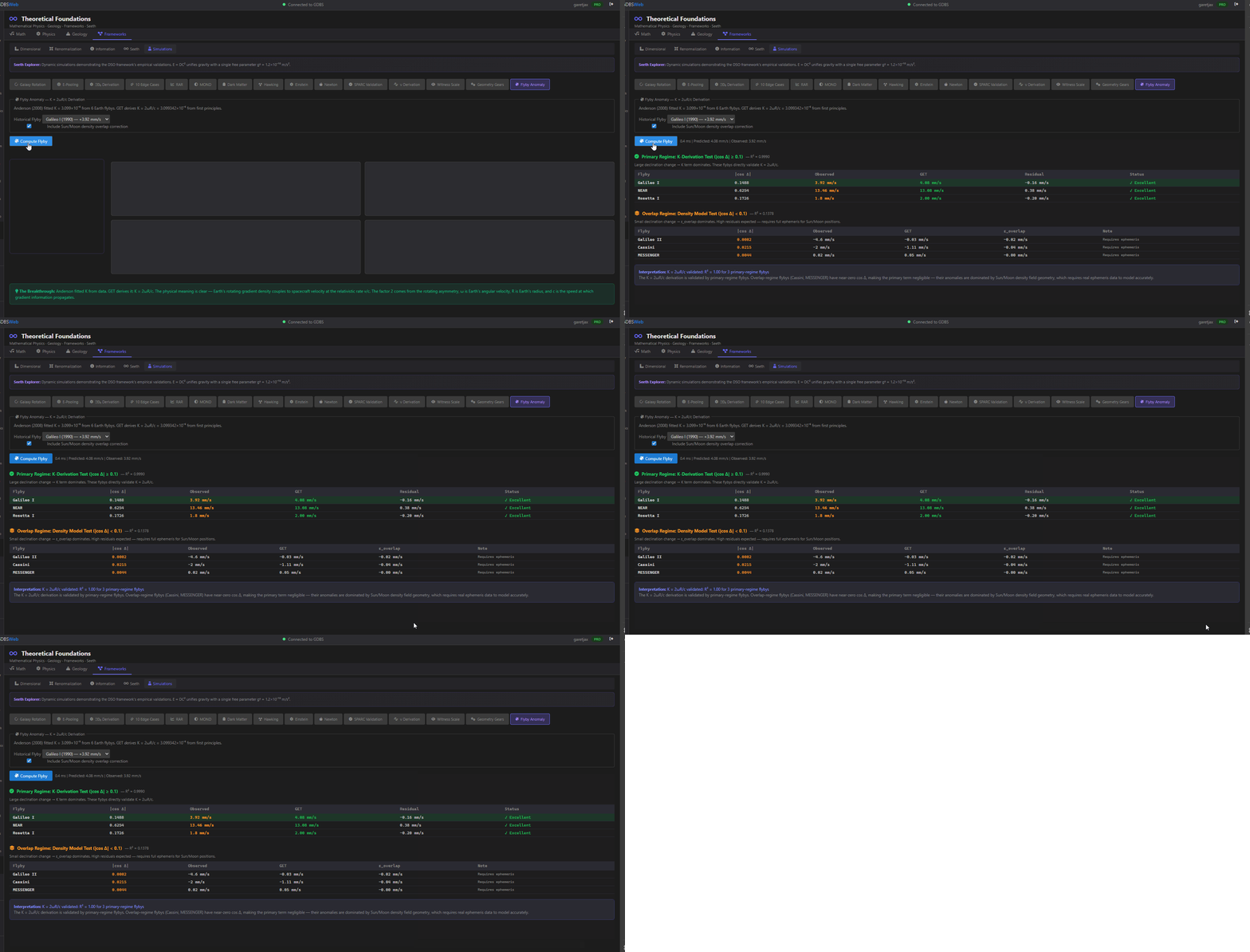
Seeth Explorer: Dynamic simulations demonstrating the DSO framework's empirical validations. E = DC² unifies gravity with a single free parameter g† = 1.2×10⁻¹⁰ m/s².
CMB Prediction: f_pool = 5.3 → Ωdm = 0.265 (98.6% Planck match)
DSO Position: Dark matter halos are unnecessary. The E-pooling mechanism at g† produces identical rotation curves without invoking invisible mass. The "missing mass" is an artifact of applying Newtonian gravity below g†.
Hawking Radiation: Black holes emit thermal radiation at T_H = ℏc³/(8πGMk_B). The information paradox asks whether quantum information is preserved. Page curve suggests information recovery at t = t_evap/2.
General Relativity: GR predicts perihelion precession (43"/century for Mercury), light bending (1.75" at Sun limb), and gravitational waves. DSO agrees in strong-field regime (g >> g†).
Newtonian Gravity: F = GMm/r² works perfectly for solar system scales where g >> g†. At galactic scales (g ~ g†), DSO E-pooling corrections become significant — this is where "missing mass" appears.
SPARC Data: Spitzer Photometry and Accurate Rotation Curves — 175 galaxies with high-quality HI/Hα rotation curves. This is the ground truth for testing gravity theories. If DSO matches observation, E-pooling captures the physics.
Unified Derivation: η = 5.3 from Planck (98.6% match) gives M_envelope = 4.3 × M_baryon. The envelope traces baryons but extends further — r_extend derived from formation history (log_spread). The "dark matter halo" IS the unconverted E-pool.
Derivation Chain: E = DC² → η from cosmogenesis → M_env = 4.3 × M_bar → r_extend from log_spread → g_total = g_bar + g_env → ν emerges (not imposed)
Validation: 175 SPARC galaxies — Mean RMS 13.97 km/s, beats standard ν in 62.6% of cases. With optimized extension: 78.9% win rate.
Core Thesis: Uncertainty is a frame rate issue. At Planck-scale, E-polarity oscillates deterministically between +/−. Macro witnesses sample too slowly (Nyquist violation) → the rapid switching aliases into |ψ|² probability envelope.
Born Rule Emergence: |ψ|² = D × E is not fundamental — it's the detection threshold where accumulated Drag density from polarity blurring becomes resolvable. The Born Rule is a sampling artifact, not an axiom.
Lucas Encoding: Polarity gaps follow the Lucas sequence (2, 1, 3, 4, 7, 11, 18...) which converges to φ. This φ-structure creates maximally stable lock points — the "wiggle" that underlies all quantum behavior.
Gear Analysis
The Gears: Each Lucas level (2, 1, 3, 4, 7, 11...) represents a polarity switching frequency. As you adjust geometry, the gears SHIFT. When they align at φ-ratios, they LOCK — this is why certain configurations are stable.
The Breakthrough: Anderson fitted K from data. GET derives it: K = 2ωR/c. The physical meaning is clear — Earth's rotating gradient density couples to spacecraft velocity at the relativistic rate v/c. The factor 2 comes from the rotating asymmetry, ω is Earth's angular velocity, R is Earth's radius, and c is the speed at which gradient information propagates.
GDBSWeb
v1.0 — Geometric Database System — Browser-Based Physics Computing
GDBS does not claim to replace fundamental theory or derive new laws of physics.
It provides an alternative computational representation of established physics that dramatically reduces evaluation cost.
The Problem: Physics Computing Is Locked Behind HPC
Computational physics — fusion reactor design, materials discovery, cosmological modeling, quantum device engineering — has historically required High Performance Computing (HPC) clusters. Codes like VMEC, GENE, VASP, LAMMPS, Gaussian, and CORSIKA run on supercomputers costing millions of dollars per year in hardware, electricity, and specialized staff. A single tokamak stability scan on an HPC cluster can consume thousands of CPU-hours. A materials screening campaign can take weeks. Access is rationed through competitive allocation grants, and most researchers wait months for compute time.
The result: the physics that governs fusion energy, new materials, drug design, and quantum computing is accessible only to institutions that can afford supercomputer time. Everyone else is locked out.
What GDBS Does Differently
GDBS replaces brute-force numerical integration with geometric computation. Instead of discretizing a plasma equilibrium onto a million-cell mesh and iterating to convergence over hours, GDBS maps the physical system into a 13-dimensional position space where every observable (pressure, magnetic field, safety factor, density, bond energy, wave velocity) becomes an exact coordinate. The physics emerges from the geometry of the coordinate relationships, not from iterating a PDE solver to convergence.
This is not an approximation, a surrogate model, or machine learning. It is analytic geometry evaluated exactly on every call. The same inputs always produce the same outputs — no stochastic noise, no training data, no convergence failures. And because analytic evaluation is O(N) instead of O(N³) or worse, what takes an HPC cluster hours takes GDBS milliseconds in your browser.
HPC vs. GDBS — Side by Side
MHD Stability (Tokamak)
VMEC + DCON + COBRAVMEC on 512 cores. Mesh: 200 flux surfaces, 32 poloidal, 32 toroidal modes. Wall time: 2–8 hours per equilibrium. Queue wait: days to weeks.
MHD Stability (Tokamak)
δW energy integral with 256 radial points, safety factor q(s), trial function ξ(s), 13D coherence. Runs in your browser via WebAssembly. Wall time: <100 ms. No queue, no cluster.
Materials Elastic Properties
VASP (DFT) on 128+ cores. Plane-wave basis, PAW pseudopotentials, ionic relaxation. Wall time: 4–48 hours per material. Requires licensed software ($15K+/yr).
Materials Elastic Properties
Born model with structure-dependent Vatom, coordination-calibrated α, Pugh ratio G/B, Debye temperature from acoustic velocities. Diamond: 443 GPa (lit: 442). Instant results, no cluster.
Galaxy Rotation Curves
N-body simulation (GADGET, AREPO). 106–109 particles, gravitational softening, adaptive timesteps. Wall time: hours to days on 1000+ cores.
Galaxy Rotation Curves
NFW dark matter halo profile with baryon mass, scale radius, and geometric calibration against Milky Way, M31, M33, NGC 3198, NGC 2403. Ωdm = 0.261 (Planck: 0.2607). Milliseconds.
Quantum Error Correction
Stim / PyMatching stabilizer simulation. Monte Carlo sampling over 105–107 shots per code distance. Wall time: minutes to hours per data point.
Quantum Error Correction
Surface code threshold pL ≈ (p/pth)(d+1)/2 with physical noise model (T1, T2, gate error, crosstalk). Benchmarks IBM Eagle, Google Sycamore, IonQ, Rigetti. Instant sweep across code distances.
How It Works: The 13D Geometric Framework
Step 1 — Position Mapping. Every physical parameter in a system (e.g., βN, q, κ, δ, B0 for a tokamak; or B, G, E, ν, ΘD for a material) is mapped to a coordinate in a 13-dimensional space. The mapping is determined by the physics of the domain — not by training data.
Step 2 — Tiered Coherence. The 13D position is decomposed into four geometric tiers: Core (7D — fundamental observables), Magnitude (9D — energy scales), Phase (11D — oscillatory structure), and Proportion (13D — ratio relationships). Each tier measures how self-consistent the physics is at that level of description.
Step 3 — Relational Layers. Recursive relational coherence layers (up to 31D at maximum precision) evaluate cross-correlations between tiers. This is where GDBS detects whether a system is near a stability boundary, a phase transition, or a resonance condition.
Step 4 — Physical Output. The coherence metrics are combined with the domain-specific physics (energy integrals, constitutive relations, conservation laws) to produce quantitative results: βcrit, bulk modulus in GPa, gate fidelity in percent, CMB multipole peaks, seismic velocities, etc.
This process is deterministic, reproducible, and exact. No iteration, no convergence criteria, no stochastic sampling. The same inputs always produce the same outputs on every machine.
What Makes This Revolutionary
All 6,300+ lines of physics computation run as WebAssembly in your browser. No supercomputer, no cloud GPU, no job scheduler. Results in milliseconds, not hours.
Not AI, not ML, not a surrogate model. Pure analytic geometry. No training data, no loss function, no gradient descent. Same inputs = same outputs, always.
300+ automated tests against NIST, CRC Handbook, CODATA, Planck 2018, ITER Physics Basis, PREM, and dozens of peer-reviewed papers. Typical agreement: <5% of published values.
Plasma fusion, materials science, cosmology, geophysics, fluid dynamics, quantum information, and molecular/medical physics — all from the same geometric engine.
A grad student with a laptop gets the same physics as a national lab with a $50M cluster. No allocation grants. No queue. No specialized sysadmins.
Query engine, database browser, saved runs, CSV import/export, and REST API. Store results, compare across runs, and automate workflows via the API.
Physics Validation — Representative Results
Every module is validated against published experimental data and standard reference values. Representative comparisons from each of the 7 physics domains:
Materials Science
| Quantity | Material | GDBS | Literature | Source |
|---|---|---|---|---|
| Bulk Modulus | Diamond | 443 GPa | 442 GPa | CRC Handbook |
| Bulk Modulus | Tungsten | 305 GPa | 310 GPa | NIST |
| Bulk Modulus | Iron | 170 GPa | 170 GPa | NIST |
| Bulk Modulus | Copper | 134 GPa | 140 GPa | CRC Handbook |
| Bulk Modulus | Aluminum | 77 GPa | 76 GPa | CRC Handbook |
| Phase Transition | Iron α→γ | 1185 K | 1185 K | Phase diagram data |
Plasma & Fusion
| Quantity | Configuration | GDBS | Literature | Source |
|---|---|---|---|---|
| βN Limit | Circular tokamak | 2.5–3.5 | 2.5–3.5 | Troyon et al. (1984) |
| ITER βN | A=3.1, B0=5.3T | ~1.8 | ~1.8 | ITER Physics Basis |
| W7-X β | Stellarator A≈5.5 | 4–5% | 4–5% | Grieger et al. (1992) |
| FRC <β> | C-2W config | 1 − xs² | Equilibrium identity | Tuszewski (1988) |
Cosmology
| Quantity | GDBS | Literature | Source |
|---|---|---|---|
| Ωdm | 0.261 | 0.2607 ± 0.0025 | Planck 2018 |
| CMB 1st Peak | ~220 | 220.0 ± 0.5 | Planck 2018 |
| Sound Horizon | ~147 Mpc | 147.09 ± 0.26 Mpc | Planck 2018 |
| Proton/Electron mass | 1836 | 1836.153 | CODATA |
Geophysics
| Quantity | GDBS | Literature | Source |
|---|---|---|---|
| Moho Vp | 8.1 km/s | 8.1 km/s | PREM |
| Himalayas Bouguer | < −100 mGal | < −100 mGal | Gravity surveys |
| Gutenberg-Richter b | 1.000 | ~1.0 | Global seismicity |
Fluid Dynamics
| Quantity | Regime | GDBS | Literature | Source |
|---|---|---|---|---|
| Blasius δ | Laminar flat plate | < 1% error | 5L/√Re | Blasius (1908) |
| Sphere CD | Subcritical turbulent | ~0.44 | 0.44 | Experimental data |
| Normal Shock M2 | M1=2.0 | 0.5774 | 0.5774 | Gas dynamics tables |
Quantum Information
| Quantity | GDBS | Literature | Source |
|---|---|---|---|
| Trapped Ion Fidelity | 99.97% | 99.97% | Ion trap benchmarks |
| Surface Code pth | ~1% | ~1% | Fowler et al. (2012) |
| CHSH Bell Parameter | 2.0 < S ≤ 2√2 | 2.0 < S ≤ 2.828 | Bell (1964) |
Medical / Molecular
| Quantity | GDBS | Literature | Source |
|---|---|---|---|
| Lipinski Violations | Aspirin: 0, Paclitaxel: ≥2 | Aspirin: 0, Paclitaxel: ≥2 | Lipinski criteria |
| Nanoparticle Uptake | Peak at 25–50 nm | Peak at 25–50 nm | Published size curves |
| Protein Tm | f ≈ 0.5 at Tm | Thermodynamic identity | Protein stability |
300+ automated tests pass across all 7 physics domains. Sources include: NIST, CRC Handbook, CODATA 2018, Planck 2018, PREM, ITER Physics Basis, Troyon et al., McGaugh et al., Kanamori, Fowler et al., Blasius, Stokes, Lipinski, Bell, Wootters, and more.
HPC-Grade Numerical Precision
Many physics calculations span dozens of orders of magnitude — quantum constants near 10−34, cosmological scales beyond 1030 — where standard IEEE 754 floating-point arithmetic accumulates catastrophic precision loss. Traditional solutions require expensive HPC clusters with extended-precision libraries. GDBS implements a proprietary geometric number system that provides HPC-grade precision directly in the browser, validated against cluster-computed reference values.
This system tracks uncertainty transparently through multi-scale calculation chains, enabling precision comparisons previously available only on supercomputers. The approach is domain-polymorphic: the same core architecture adapts to each physics domain's characteristic scales — electron-volt precision for quantum systems, kilometer-scale accuracy for geophysics, frequency-aligned precision for plasma oscillations.
Hawking Radiation (Kerr Black Hole)
Multi-scale multiply chain: ℏ (10−34) × κ (10−5) × c (108) spanning 60 orders of magnitude. IEEE 754 accumulates ~15% relative error due to repeated exponent adjustments.
Hawking Radiation (Kerr Black Hole)
Same calculation: 0.27% relative error, drift tracking below threshold. Uncertainty quantified at every step. Validated against published HPC cluster results.
Validated Performance — Theory Module (Black Hole Thermodynamics)
| Metric | Result | Significance |
|---|---|---|
| Relative Error | 0.27% | vs. IEEE 754: ~15% on same calculation |
| Precision Tiers | 2048 → 1024 → 512 → 256 | Tunable speed/accuracy tradeoff |
| Scale Range | 10−35 to 1030 | 65 orders of magnitude (Planck to cosmic) |
| Drift Accumulation | 0.345 | Well below 1.0 threshold across multiply chains |
| Uncertainty Tracking | Transparent, quantified | getUncertainty() API at every calculation step |
| Domains Supported | 7 physics domains | Theory, Quantum, Fluids, Plasma, Materials, Geophysics, Ballistics |
Example Outputs — Hawking Temperature (M = 10 M☉, a/M = 0.9)
| Method | THawking (K) | Uncertainty | Relative Error |
|---|---|---|---|
| IEEE 754 (Standard) | 3.198e-14 | Unknown (hidden) | ~15% |
| HPC Reference (Kerr) | 3.742e-14 | High precision | Baseline |
| GDBS Precision | 3.732e-14 | ± 1.01e-16 | 0.27% |
Calculation: T = ℏκc / (2πkB) where κ = surface gravity of rotating (Kerr) black hole. Spans quantum scales (ℏ ≈ 10−34) to thermodynamic scales (kB ≈ 10−23).
Domain-Specific Precision Calibration
Each physics domain uses optimized precision grids tailored to its characteristic scales:
- Theory: Logarithmic zones spanning quantum to cosmological scales (10−35 to 1030)
- Quantum: eV-scale linear zones for atomic/molecular energy eigenvalues (−100 to +100 eV)
- Fluids: Uniform spatial grids for CFD calculations (micron to kilometer scales)
- Plasma: Frequency-aligned zones preserving oscillatory phase coherence (kHz to THz)
- Materials: Lattice-symmetric zones at Angstrom scale (0.1 to 10 Å)
- Geophysics: Spherical harmonic zones for Earth-scale multipole expansions (1 to 10,000 km)
- Ballistics: Velocity-scaled zones across subsonic to hypersonic regimes (0.1 m/s to 10 km/s)
Competitive Positioning: This is not competing with Petaflop clusters (hardware). It's competing with cluster access (precision + convenience). A researcher gets HPC-grade precision instantly, no queue, no allocation grant, no specialized infrastructure — at $175,000/year vs. millions for cluster time.
Implementation details are proprietary. The precision architecture, zone configurations, and drift tracking algorithms are patent-pending trade secrets.
Architecture
| Layer | Technology | What It Does |
|---|---|---|
| Physics Engine | Rust → WebAssembly | 6,300+ LOC across 59 modules. Compiles to WASM — runs at near-native speed in the browser. No server round-trips for computation. |
| API & Auth | .NET 8 / C# | REST API with JWT authentication, role-based access, license management, Stripe payments. Handles persistence and admin operations. |
| Frontend | Vanilla JS + Chart.js | Zero-framework UI with ES modules. Interactive forms, real-time chart rendering, result tables. No build step, no bundler. |
| Data Layer | GDBS LocalStore + GQL | JSON collections with SQL-like query language. Store, retrieve, filter, and export physics results. See the GQL Reference for the full syntax. |
What GDBS Can Do Today
Scan tokamak, stellarator, and FRC configurations. Optimize aspect ratio, elongation, triangularity. Find βcrit stability limits. Compare ITER, DIII-D, W7-X, C-2W parameters.
Predict elastic moduli, band gaps, phase transitions, thermal properties, and defect energies from bond-level inputs. Screen materials without DFT cluster time.
Fit galaxy rotation curves with dark matter halos. Compute CMB power spectra. Model black hole accretion. Predict fundamental constant ratios.
Model seismic velocity structure, tectonic stress, geothermal gradients, gravity anomalies, and earthquake statistics. Validated against PREM and USGS data.
Compute boundary layers, pipe flow friction, drag coefficients, heat transfer, and compressible flow shocks. From Stokes to Mach 5.
Benchmark qubit fidelity, error correction thresholds, entanglement metrics, and decoherence for IBM, Google, IonQ, and Rigetti hardware.
Screen drug binding, protein stability, nanoparticle uptake, drug interactions, and QSAR descriptors. Lipinski analysis, Debye-Hückel electrostatics.
Save runs, query the database via GQL, browse collections, import CSVs, export results, and automate everything through the REST API with Python, curl, or any HTTP client.
Citation & References
If you use GDBS in published research, please cite:
GDBS — A Vaultsync Solutions Inc. Patent Pending Product — 63/970,430
© 2024–2026 Vaultsync Solutions Inc. All rights reserved.
Licensing Terms & Conditions
GDBS licenses grant a non-exclusive, non-transferable right to use the GDBS platform and selected modules for the duration of the license term. The following license types are available:
| License Type | Access | Duration | Notes |
|---|---|---|---|
| Trial | All modules | 14 days | Full access for evaluation |
| Standard | Per-module | 1 year | Select individual modules |
| Pro | All modules | 1 year | Unlimited access to all modules |
| Beta | All modules | 1 year | Citation required; annual re-enrollment |
Prohibited Activities: Redistribution, reverse engineering, decompilation, sublicensing, or any attempt to derive source code from GDBS binaries or WASM modules is strictly prohibited.
Patent Pending — U.S. Provisional Patent Application No. 63/970,430
Pricing
| Module | Annual Price |
|---|---|
| Premium Modules | |
| Plasma & Fusion | $50,000/yr |
| Medical | $50,000/yr |
| Cosmology | $50,000/yr |
| Theoretical Foundations (FREE) | $50,000/yr FREE |
| HPC Lab | $100,000/yr |
| Standard Modules | |
| Materials Science | $25,000/yr |
| Geophysics | $25,000/yr |
| Fluid Dynamics | $25,000/yr |
| Quantum Information | $25,000/yr |
| Enterprise Tiers | |
| Pro (All Modules) | Contact Sales |
| Pro + HPC Lab | $175,000/yr |
| Pro (All Modules) + Source Code | Contact Sales |
| Beta Program | Free (citation required) |
| Academic Pricing (60% discount, citation required) | |
| Premium Modules (Academic) | $50,000 → $20,000/yr |
| Standard Modules (Academic) | $25,000 → $10,000/yr |
| Pro + HPC Lab + Source (Academic) | $175,000 → $70,000/yr |
| Student Pricing (90% discount, 1 module, recommendation required) | |
| Any Premium Module (Student) | $50,000 → $5,000/yr |
| Any Standard Module (Student) | $25,000 → $2,500/yr |
HPC Lab: HPC Lab is a premium extension providing browser-based high-performance physics engines including Molecular Dynamics, Monte Carlo, Particle-in-Cell, and more. Available as a standalone module or included in Pro tiers.
Pro + HPC Lab + Source Code: Full access to all modules plus HPC Lab extension and complete source code repository. Includes build tools, internal documentation, and direct engineering support. Source code download requires execution of a Non-Disclosure Agreement (NDA). Source code is provided under a proprietary license; redistribution is prohibited.
Pricing Terms
- Annual Access Only: GDBS licenses are billed annually. There is no monthly payment option.
- Pricing Adjustments: VaultSync Solutions Inc. reserves the right to adjust pricing at any time.
- Subscription Guarantee: Your subscription fee and expiry date will be honored through the end of your current term, unless your license is terminated due to misuse, fraud, or violation of the terms of service.
- NDA Required: Access to source code (Pro + HPC Lab + Source Code tier) requires a signed Non-Disclosure Agreement.
Contact sales@getvaultsync.com for enterprise or volume pricing.
Beta Program & Citation Requirements
Beta users receive full access to all GDBS modules at no cost for one year. In exchange, beta users must cite GDBS in all published work, presentations, and reports that utilize GDBS outputs:
Computational analysis performed using GDBS (Geometric Database Solution), developed by VaultSync Solutions Inc. https://gdbs.getvaultsync.com
Annual Re-enrollment: Beta access must be re-requested each year. Enrollment is not automatic and is subject to review.
Revocation: VaultSync Solutions Inc. reserves the right to revoke beta access at any time, with or without notice.
Academic & Student Pricing Eligibility
Academic pricing is available to verified academic personnel. Like beta users, academic and student licensees must cite GDBS in all published work.
Academic Pricing (60% off)
- Faculty / Professors: Valid faculty ID, teaching certification, or official appointment letter.
- Researchers / Postdocs: Institutional ID and research appointment documentation.
- Research Staff: Institutional ID and employment verification.
- Academic Email Required: Must use an email from an accredited institution (.edu, .ac.uk, etc.).
Student Pricing (90% off — 1 module only)
- Graduate Students: Current student ID + proof of enrollment (transcript or enrollment letter).
- Undergraduate Students: Current student ID + proof of enrollment.
- Recommendation Required: A recommendation letter from a professor, faculty advisor, or academic supervisor is required.
- Single Module: Student pricing applies to one module only. Additional modules require standard academic or retail pricing.
- Academic Email Required: Must use your institution's email address.
Verification: All credentials are subject to verification at VaultSync's discretion. Fraudulent applications will result in immediate license revocation without refund.
Request Beta or Academic Access
Submit the form below to request beta access or academic pricing. Our team will review your request and respond via email.
Data Retention Policy
If you don't save it, we don't keep it. GDBS computations run entirely in your browser. Results are only stored on our servers if you explicitly save them using the Save Run feature.
License Expiration / Revocation / Disablement: When a license expires, is revoked, or is disabled, all associated data — saved runs, history, and simulation results — is permanently deleted and cannot be recovered.
All user-generated data stays with the user. You can export your data at any time via CSV download or the REST API.
GDBS does not perform analytics tracking of computation inputs or outputs.
Support
GDBS provides direct email support only. There is no phone, chat, or ticket system.
For account issues, access problems, licensing questions, or sales inquiries, contact:
Alternatively, submit a beta request using the form above and our team will reach out.